Custom Cat Portrait
Pet Pic Portraits · Editorial
Portraits of the Quietly Significant · No. I
On the cat as subject.
Editorial · 6 min read · Mercy, Fur Baby Mama
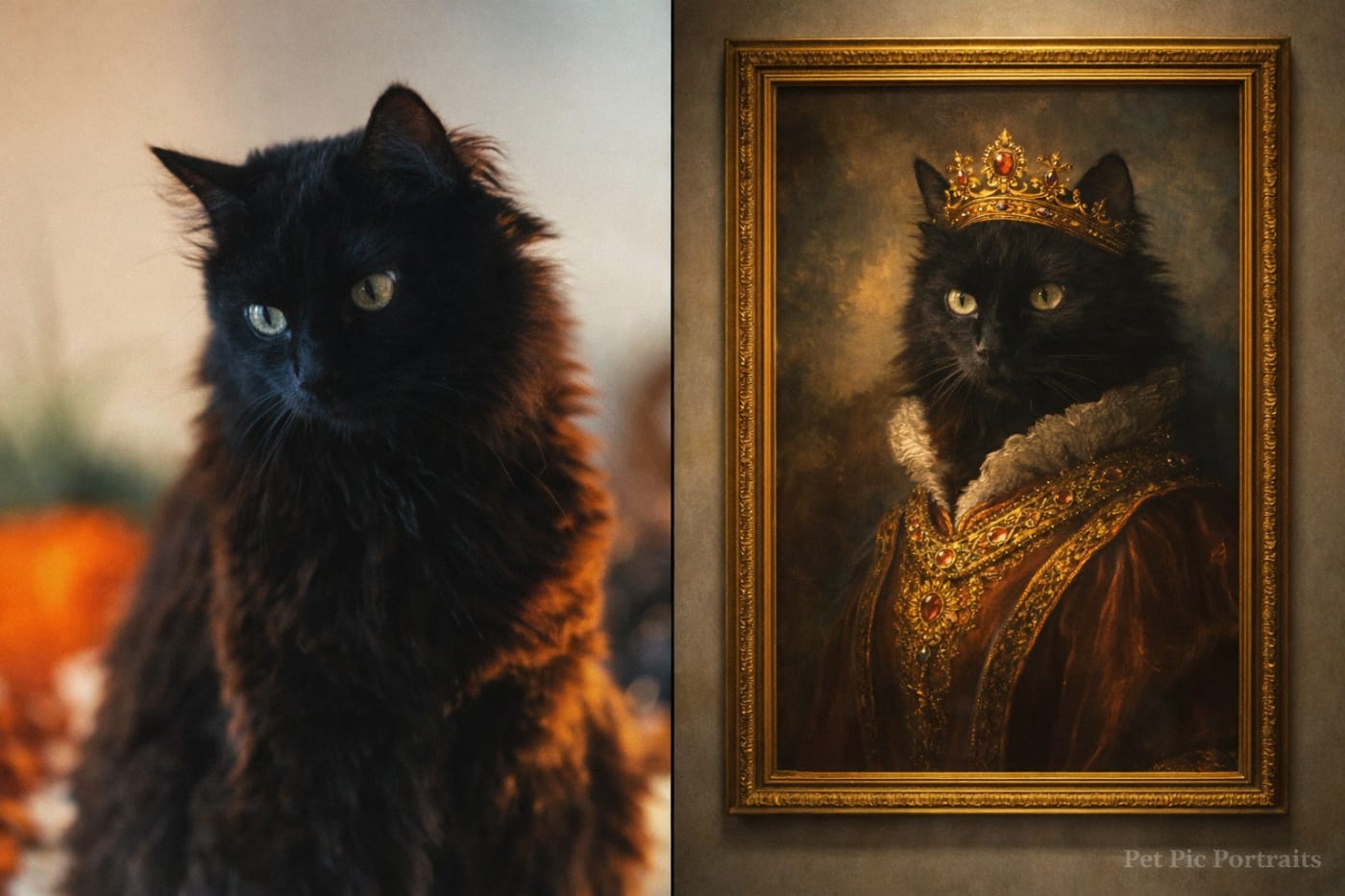
Plate I. The Cat in the Old Masters tradition. Rendered by Pet Pic Portraits.
There is a tradition, older than photography and considerably more serious, of treating the cat as a worthy subject for paint.
Théophile Steinlen drew them across the café walls of Belle Époque Paris — not as ornament, not as background, but as the central presence, the one the eye went to first. Henriëtte Ronner-Knip devoted the better part of the nineteenth century to them in Dutch oil: a single cat, warm light falling from the left, a darkness behind her that asked the viewer to look more closely. Louis Wain made an entire early-twentieth-century career of the form. And before any of them, the Old Masters had already established the grammar — a single subject, soft studio light, a warm palette, a darkness that frames without competing. A visual language that carries gravity. That says: this one matters.
The cat has been painted seriously, in other words, for three hundred years. The format for a serious cat already exists.
Most cats today, however, exist in folders. Between three and four thousand photographs deep, on a phone, in a cloud account, backed up somewhere and retrieved almost never. The slightly out-of-focus one where she glanced up at a sound you never identified. The one taken from above, looking down on her while she looked at something else. The one taken in low evening light where her eyes came out exactly the color of new copper — and you have never been able to replicate it since because you do not remember which lamp was on. You have shown that photograph to two close friends, and no one else. None of them on a wall. None of them on paper. None of them framed.
The photograph is evidence she existed in a moment. It is not a portrait of who she is.
Plate II — The Camera Roll
A confession, in passing.
You know exactly which photographs these are.
The one where she is stalking a houseplant from behind the couch leg, with the absolute seriousness of a small animal who has decided this is the moment. The one where she fell asleep draped across the wrist of your working hand — not your laptop, your actual wrist — and you typed around her for forty minutes because she had finally, finally settled, and you were not going to be the one to move. The one taken at six in the morning, half-dark, where the flash caught her mid-blink and instead of deleting it you kept it because something in the blur was exactly her. These photographs are private. They are not portraits.
A portrait is a different object with a different intention.
A portrait says: this one. Not cats in general; not the breed; not a pleasant print of an animal for a wall that needs something on it. Her. The specific way she drops one shoulder when she is about to make a decision about you. The particular quality of her attention when she hears you in the next room but is not yet certain you deserve a response. The look she gives the window at the same hour every afternoon. A portrait carries that across a room. Across a decade. A portrait is what you make when you want someone — someday, anyone — to know that she was her.
Plate III — On How a Portrait Is Made
The process, plainly.
The process is simple, and we think it is important to be plain about what it is.
You upload a photograph. The best one, or the one where the lighting was poor but it is the only photograph that captures the way she holds her ears — that one. The image is processed by an AI model trained on the compositional language of Old Masters oil portraiture: warm palettes, soft directional light, a dark studio ground, the visual grammar that has carried seriousness since the seventeenth century. A rendering of your cat in that tradition is returned.
Then Mercy reviews it.
Mercy is a real person, and the review is a working studio review, not a marketing claim. She compares the rendering against your original photograph and looks specifically for the things that distinguish your cat from all other cats: the chest markings, the ear shape, the precise color of the eyes, the one whisker that does not cooperate. She looks at the way the face sits. She looks at the likeness. If the portrait does not resemble her — actually, specifically resemble her — it does not ship. She requests a re-render. She does this as many times as necessary.
We do not claim it is hand-painted. It is AI-rendered. Reviewed by hand. Fully disclosed — because that is the only way the portrait is worth what you paid for it.
Plate IV — On Frames and Paper
The object itself.
A portrait rendered and never printed is still a file. What we make is an object.
The print is produced on archival Hahnemühle Fine Art paper — a German mill whose paper has been used by printmakers and photographers working for permanence since 1584. Museum-grade, in the literal sense: the same paper standard used by institutions that are building collections meant to outlast the people who made them. Your cat's portrait is printed by a fine art printing partner held to those standards, and it arrives — if you choose the framed configuration — already dressed for a wall.
The framing is custom to the portrait. Twenty-two frame collections: gilt and walnut and ebony and antique brass and others; twenty-eight mat colors; four glazing options, including UV-filtering glass for works that will hang in rooms with natural light. The combination is not chosen by algorithm. You choose it. We want it to look like something you selected, because you did.
Most framed cat portraits land between $200 and $500, depending on size, mat, and frame. Premium configurations — larger work, ornate frame, UV glazing — run up to roughly $1,400. For those who already work with their own framer, or whose walls are already spoken for, the high-resolution digital file is available from $37.
Plate V — On Memorial Portraits
For the cat who is no longer here.
Half of the cat portraits we render are for cats who are no longer here.
People write to us about an eighteen-year-old who slept on the same side of the bed, every night, for fourteen of those years — and the bed now has a cold spot at four in the morning that has not resolved itself. A black cat from the shelter who was supposed to be a temporary foster and stayed for nine years. A tortoiseshell who crossed the bridge in November, and whose photographs still surface in the phone's memory feature on random Tuesdays, in the worst possible way. They write to us about cats they are not ready to stop looking at.
The reason for commissioning is the reason oil portraiture has existed for five hundred years. The photograph, eventually, stops being enough. Not because it is insufficient, but because you need something that operates differently — that hangs on a wall in a room you live in, that holds still when you look at it, that exists as an object and not only as a file. The painting carries forward what the camera was never built to carry.
We treat memorial portraits with extra care. By which we mean: Mercy looks at them longer. Stricter standards on likeness. Extra rounds of review on the markings that made her herself. If you are commissioning for this reason, write us a sentence about her — her name, what she did, what you would want a stranger who never met her to understand. We pass it to Mercy with the file. It becomes part of how she looks at the work.
"There are some portraits I keep open on my screen for a while before I send them. The ones for cats that aren't here anymore. You can feel the difference in the file, somehow. I take a little longer with those."
— Mercy
Memorial portraits are priced the same as any other commission. $200 to $500 for most framed configurations; up to roughly $1,400 for premium sizes and frames; $37 for the digital file alone. There is no separate memorial tier. It is the same care and the same craft — with a slightly heavier hand on the review.
Plate VI — A Brief Catalog of Other Subjects
Thirty-four styles. The classical oil is the anchor.
Oil painting in the Old Masters tradition is what we lead with, because that register holds up on a wall, frames most beautifully, and carries the longest. After you upload, you can preview your cat in any of thirty-four treatments — watercolor, Art Deco, Victorian, pop art, Pharaoh, Cosmic Explorer, and more — and choose the one that feels most like her. A small selection follows.

Black cat. Egyptian dynasty register. The cat, of course, was sacred. This style knows that.

Maine Coon. Inverness coat. A gaze that has already solved it and is simply waiting for you to catch up.

Russian Blue. Geometric framing, minimal palette, the sharp economy of a twenties illustration. The cat as object of considered design.

Siamese. For the cat who is, evidently, in possession of information she has chosen not to share.

Tabby. Flat color, bold line, the cat as icon — which is to say, the cat as she has always understood herself.

Persian. Far from home. For cats who scream at things you cannot see and are probably right.
Plate VII — On the Reviewer
Mercy, the eyes before the print.
Mercy reviews every portrait before it ships. She has been doing this work since the beginning.
She is also a pet owner. Yogilove — her Shih Tzu Terrier, eleven years old, who has been with her long enough to constitute a chapter — and Miabelle, her Shih-Poo, who is tolerated by the household's feline residents with the specific patience that comes from knowing you are, in fact, loved. Mercy knows, without needing to be reminded, what an owner looks for when she sees the proof of her own pet — because she does it herself, every time, with hers. She looks for the thing that makes this one herself.
"If she doesn't look like herself, I send it back. I would know in two seconds if it were my own. So I know with yours."
— Mercy · Fur Baby Mama
Common Questions
Is this hand-painted? +
What if the AI doesn't capture her right? +
What does it cost? +
Can I get her in different styles? +
What about a memorial portrait? +
How long does it take? +
What if I don't like it? +
In Closing
A cat is not a decoration, and a photograph of her is not a portrait.
A portrait is a deliberate object. It is made with intention, for a wall, in a room where you live, so that she is present in it — specifically, not generally — for as long as the paper holds. We make those portraits, in the Old Masters oil tradition, printed on archival Hahnemühle paper, custom-framed to the standard a small museum would meet, and reviewed by a person who looks at every one before it ships.
The Old Masters gave duchesses that gravity. Your cat has earned it too.
Of her. Specifically her.